This material is available in other languages:
ru
25 Sep 2026
Violence, discrimination and detention: key points from two Memorial HRDC submissions to CEDAW
- Migrant women and detention. Submission with the Global Detention Project
- Violence, discrimination and the situation of women in detention. Submission with Coming Out and OVD-Info
- What questions do the human rights organisations propose asking Russia?
The Memorial Human Rights Defence Centre, together with other human rights organisations, submitted two reports to the UN Committee on the Elimination of Discrimination against Women (CEDAW Committee), proposing issues for the Committee to raise with the Russian authorities ahead of its consideration of Russia’s tenth periodic report on the implementation of the Convention on the Elimination of All Forms of Discrimination against Women.
Background
The CEDAW Committee periodically reviews how States parties implement the Convention on the Elimination of All Forms of Discrimination against Women. It examines States’ periodic reports, holds a dialogue with government representatives, and issues recommendations.
Russia submitted its tenth periodic report on 24 November 2025.
At its 93rd session, scheduled for 5–30 October 2026, the Committee is expected to adopt a List of Issues for Russia — a preparatory stage ahead of the review of the State party’s report.
It is for the preparation of this List of Issues that Memorial HRDC and other organisations submitted information on violations of women’s rights.
Russia remains a party to the Convention on the Elimination of All Forms of Discrimination against Women and its Optional Protocol, which allows individuals to submit communications to the Committee alleging violations of rights protected under the Convention.
The first submission, prepared together with the Global Detention Project, focuses on the detention of migrant, refugee, and asylum-seeking women, conditions in immigration detention, trafficking in persons, the re-detention of Ukrainian nationals, and the recruitment of migrant women for Russia’s war against Ukraine.
The second submission, prepared together with Coming Out and OVD-Info, addresses the situation of women in the North Caucasus, the lack of effective protection against trafficking in persons, discrimination based on sexual orientation and gender identity, and violations of the rights of women in detention.
Below is a brief overview of the two submissions.
Migrant women and detention. Submission with the Global Detention Project
Even women with newborn babies are placed in immigration detention centres
The authors note that Russian legislation does not provide specific safeguards protecting pregnant women and mothers with young children from placement in Centres for Temporary Detention of Foreign Nationals (CTDFNs) pending deportation or administrative expulsion.
They cite a 2024 case in which a Tajik woman was placed in the Ekaterinburg CTDFN with her baby just four days after giving birth.
Another problem is the re-detention of people whose removal cannot be carried out. After their release, they are not issued documents allowing them to reside legally in Russia and therefore remain at risk of being detained again. Stateless persons are particularly vulnerable.
Women lack adequate healthcare and hygiene supplies
According to the submission, many CTDFNs continue to lack specialised doctors, including reproductive health specialists, while access to specialist care for chronic conditions remains limited.
Hygiene supplies are insufficient; menstrual products are generally provided by relatives and volunteers, while toilets in accommodation areas often lack proper partitions or doors.
The authors also highlight overcrowding and the absence of effective independent monitoring, which increases the risk of sexual harassment and gender-based violence.
Victims of trafficking are punished for immigration violations
Russia lacks an effective system for identifying and assisting victims of trafficking in persons, meaning that victims may instead be treated as immigration offenders and detained because they lack lawful status, the authors argue.
The submission refers to a 2024 judgment of the European Court of Human Rights. In F.M. and Others v. Russia, the Court identified systemic shortcomings in Russia’s protection of women who had been trafficked. In particular, it found that Russian law fails to recognise that consent obtained through coercion is invalid and does not adequately account for forms of trafficking that do not involve physical force.
Despite the Court’s findings, the Russian authorities subsequently issued a deportation order against one of the applicants instead of ensuring that she received protection and assistance.
Ukrainian nationals are re-detained after completing their sentences
The authors describe cases in which Ukrainian nationals, after serving criminal sentences, are placed in CTDFNs for alleged immigration violations even though, because of the war, their removal to Ukraine cannot be carried out. In 2024, a UN Special Rapporteur reported 250 documented cases of this practice.
The organisations propose that the Committee ask Russia what measures it is taking to prevent such repeated deprivation of liberty, particularly in the case of women.
Migrant women are recruited for the war in exchange for release
The submission contains information about the recruitment of imprisoned women from Central Asia for deployment in Russia’s war against Ukraine in exchange for release. Some are reportedly sent to perform combat-related tasks, while others work as cooks, cleaners, or medical personnel.
Women sent to the front have reported violence, lack of medical care, threats of extrajudicial punishment, and the effective impossibility of withdrawing from military service.
The authors propose that Russia be asked to disclose how many foreign women have been recruited and to explain what measures are in place to prevent coercion and investigate offers of release in exchange for military service.
Violence, discrimination and the situation of women in detention. Submission with Coming Out and OVD-Info
Women in the North Caucasus are not adequately protected from violence or separation from their children
The organisations report continuing cases of domestic violence, abductions, and so-called “honour killings”, as well as the pursuit of women who have fled their relatives beyond both the region and Russia.
Other violations highlighted by the authors include female genital mutilation, particularly in Dagestan, and attempts by officials and groups operating with the authorities’ acquiescence to control women’s clothing, appearance, and personal behaviour.
A separate concern is the removal of children from their mothers after divorce. Fathers and their relatives may disregard even court rulings in women’s favour, while the authorities fail to ensure that such decisions are enforced.
The authors also note that women in the North Caucasus are increasingly becoming direct targets of political persecution, including for anti-war statements and social media posts.
Courts overlook indicators of trafficking in cases involving women who returned from Syria
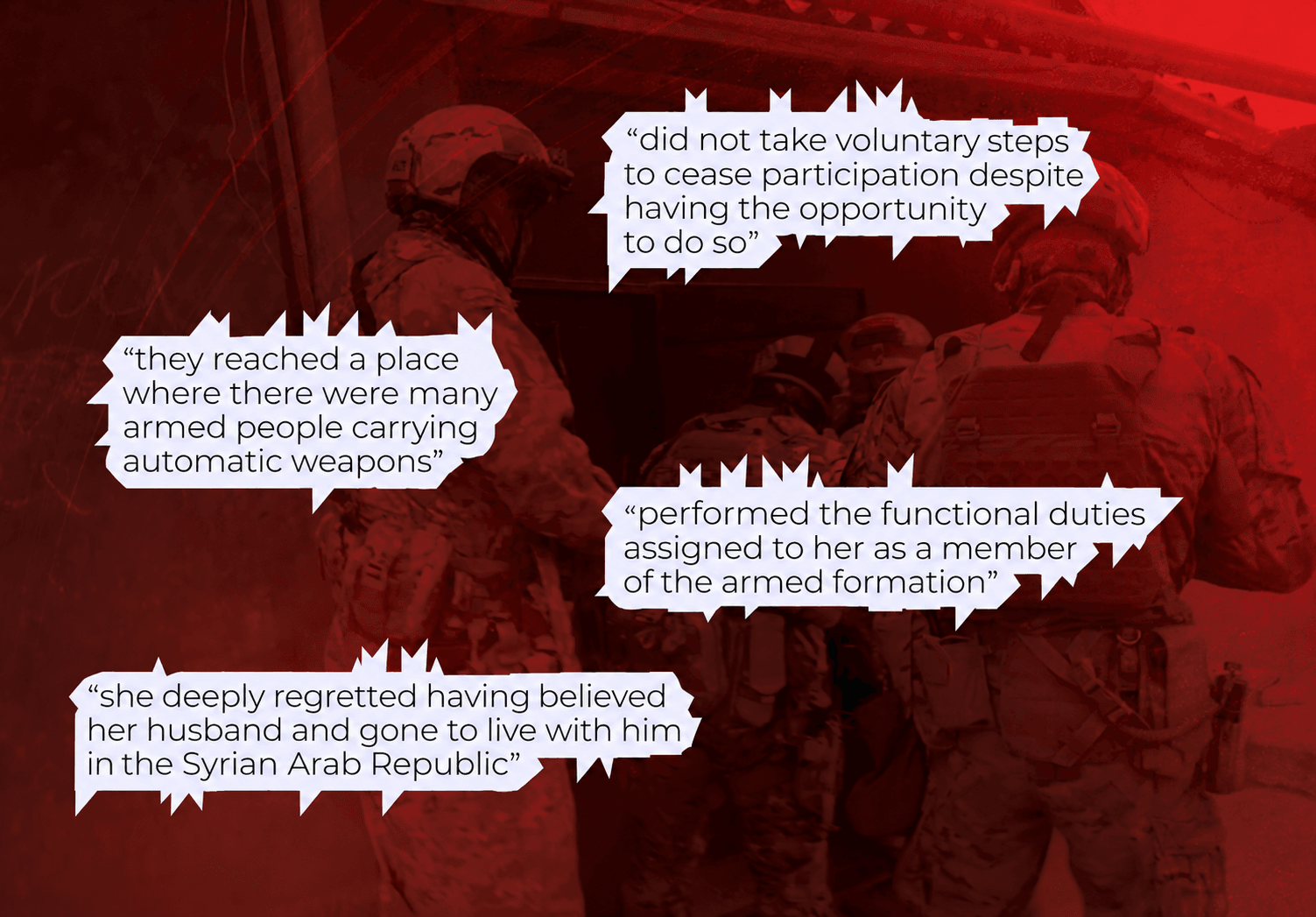
Memorial HRDC analysed 50 court cases involving women who returned from Syria. In at least 33 of them, testimony contained indicators of trafficking in persons, including deception, coercion, abuse, confiscation of documents, and severe restrictions on freedom of movement.
Nevertheless, courts failed to properly assess these circumstances and treated activities such as cooking, washing clothes, sewing, and caring for family members under conditions of captivity as participation in illegal armed formations.
When concluding that the women had had a “real opportunity” to leave voluntarily, courts did not explain how this would have been possible without documents or money, while accompanied by young children and amid active hostilities.
As a result, women who may themselves have been trafficking victims received prison sentences ranging from three to eight and a half years, without any formal mechanism for victim identification or rehabilitation.
LGBTQ+ women face prosecution, pressure and sexualised violence
The authors link increasing discrimination to the prohibition of so-called “LGBT propaganda”, the designation of the so-called “International Public LGBT Movement” as an extremist organisation, and legal restrictions affecting transgender people.
According to Coming Out, a transgender woman may face administrative prosecution simply for presenting as a woman while her identity documents still reflect the sex assigned to her at birth.
Women in same-sex families face pressure from educational and medical institutions, threats of referrals to child protection or law enforcement authorities, and the risk of dismissal from employment.
The submission also describes so-called “corrective” sexualised violence, in which perpetrators explicitly state that they intend to “correct” a victim’s sexual orientation or gender expression.
The prison system fails to take women’s needs into account
According to the authors, rules governing detention are designed predominantly around male prisoners, while women’s circumstances are taken into account mainly in relation to pregnancy and motherhood, with insufficient attention paid to previous experiences of violence, privacy, and gender-specific medical and psychological needs.
Women report being subjected to strip searches while video cameras remain switched on, shortages of personal hygiene products, limited access to showers and toilets, and difficulties obtaining qualified medical care.
The submission also describes cases in which handcuffs were used shortly before, during, or immediately after childbirth, as well as cases in which mothers were separated from their newborn babies for several days.
Work shifts in prison sewing facilities may last 12–15 hours, while refusal to perform additional unpaid maintenance work can result in disciplinary sanctions.
Women political prisoners report additional pressure related to their views, including more frequent disciplinary penalties, prejudicial treatment, and stricter censorship of correspondence.
The authors separately describe torture and the detention of captured Ukrainian women in secret places of detention, as well as the recruitment of imprisoned women for the war in exchange for promises of pardon.
What questions do the human rights organisations propose asking Russia?
In the first submission, the authors propose asking the Russian authorities about measures to protect vulnerable migrant women from detention, improve conditions in CTDFNs, assist victims of trafficking in persons, and prevent women from being coerced into participation in the war.
In the second, the proposed questions concern legislation on domestic violence, the protection of women in the North Caucasus, mechanisms for identifying trafficking victims, ending discrimination against LGBTQ+ women, and ensuring adequate conditions, healthcare, and protection from violence for women in detention.