This material is available in other languages:
ru
10 Jun 2026
Wave of Detentions Targets Muslim Religious Figures in Russia
Throughout May 2026, pro-government Russian media reported arrests of Muslim clergy members and their associates in several regions of Russia.
What is known
In St. Petersburg, the former chair of the “Community of Muslims of the North-West”, Mohammed Henni, was placed in pre-trial detention. His relative, Regina Henni, was also arrested.
In the Prigorodny District of North Ossetia, in the village of Chermen (Bazorkino), Ingush theologian and public figure Akhmed Tangiev was detained. Between 2008 and 2010, he served as deputy mufti of Karelia under Wissam Ali Bardwil. Security forces arrived at 6 a.m., conducted a two-hour search involving checks of electrical equipment and questioning of residents. Tangiev was then taken for questioning and later transferred to St. Petersburg.
In the same case, authorities arrested El Hih Nidal Awadalla Ahmed, deputy mufti of the Saratov Region and teacher at the Sheikh Said madrasa. Media outlets also reported the detention of several others, without providing further details: R. F. Galeyev, Zh. K. Sadirov, M. R. Jebril, and R. E. Tarkhanov.
The detainees are suspected of involvement in the activities of the organisation “Muslim Brotherhood”, which is designated as a terrorist organisation in Russia under Article 205.5(2) of the Criminal Code. They are also accused of attending meetings in St. Petersburg linked to the movement. The investigation cites, among these gatherings, sessions of the “Forum of Muslim Organisations”, held on 12 April and 27 September last year on Vasilyevsky Island.
In Saransk, authorities detained the head of the Spiritual Administration of Muslims of Mordovia, Rail-khazrat Asainov, along with five members of the local community, on suspicion of bribery related to university entrance examinations for a master’s programme in Islamic Economics and Finance at Mordovia State University. On 21 May, Asainov’s lawyer reported that he had been released.
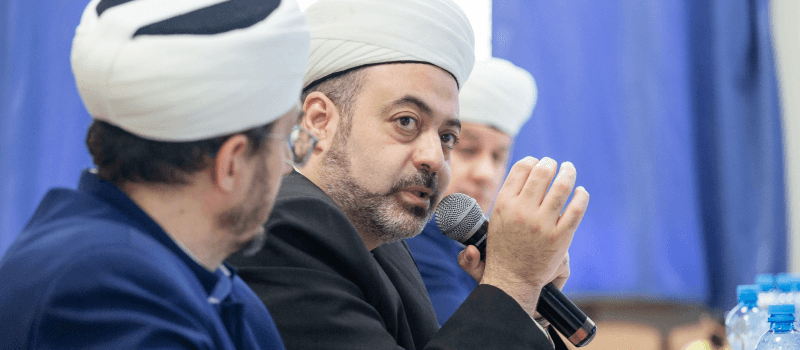
On 20 May, Moscow’s Tagansky District Court confirmed the 15-day administrative arrest of the imam of the mosque in South Butovo and former mufti of Karelia, Wissam Ali Bardwil. He is alleged to have refused to show documents to police at an airport, attempted to flee, and resisted arrest.
According to media reports, the prosecutions are linked to the Spiritual Administration of Muslims of Russia and its head, Mufti Ravil Gainutdin.
Expert commentary
The organisation “Muslim Brotherhood”, which is widespread in the Middle East, was banned in Russia as a “terrorist organisation” by the Supreme Court in 2003, alongside the political organisation Hizb ut-Tahrir.
In 2001, the FSB stated that the organisation’s structures had been identified in 49 regions of Russia and in CIS countries, and that it allegedly directed the armed underground in Chechnya. However, until recently, no criminal cases had been brought in Russia specifically against the Muslim Brotherhood.
As far as is known, it was mentioned only once in an extradition case connected to Uzbekistan, where a native of the Middle East reportedly told fellow believers in Murmansk about the banned organisation.
The Federal List of Extremist Materials includes only two works by Muslim Brotherhood ideologue Sayyid Qutb, published in Russian: The Future Belongs to Islam and Milestones on the Path of Allah, which were banned by courts between 2010 and 2012.
In practice, there has been no visible activity by the Muslim Brotherhood in Russia in recent decades. There are no known printed, electronic, audio or video materials in Russian issued under the organisation’s name.
It is therefore reasonable to assume that, within established law-enforcement practice, such accusations are based on expert assessments of suspects’ statements, social media activity, or seized literature. However, the objectivity and competence of such assessments are often questioned.
It cannot be ruled out that expressions of sympathy for the ideas or activities of the Muslim Brotherhood abroad — particularly when made by nationals of Arab countries living in Russia — may be interpreted by the authorities as propaganda of a banned organisation.
In the Russian context, there is a clear distinction between Hizb ut-Tahrir, whose activity in Russia during earlier periods was visible and widespread, and the Muslim Brotherhood, whose activity in the country can only be described in hypothetical terms.